For restaurants, food trucks and caterers
Your restaurant HACCP plan, drafted with the Food Code limits already filled in
Doing sous vide, vacuum packing, cook-chill, curing or sushi rice? Your inspector will want a written HACCP plan. Answer a few questions and you'll get the flow diagrams, hazard analysis, critical limits and monitoring logs, each limit cited to the FDA Food Code 2022.
First process free, no account. All processes and Word export $79 once.
Live output from the plan generator
Flow · tap a CCP
- Prepare / portion
- Serve
CCP 4 · Critical limit
Cool
135°F
135°F to 70°F within 2 hours, and 135°F to 41°F within a total of 6 hours
- Source
- Food Code 2022 §3-501.14(A)
- Monitor
- Record product temperature at start (135°F), at 2 hours, and until 41°F is reached (at least hourly). Use shallow pans (≤2 in. depth), ice baths, ice wands, or a blast chiller.
14
processes with cited limits
5
printable monitoring logs
$79
once, not a subscription
14
days to ask for a refund
Real output, not mockups
What you get when you're done
Everything a reviewer expects to see under Food Code §8-201.14, in a file you can edit.
01
CCP summary with cited limits
165°F for poultry, 135°F to 70°F in 2 hours, 34°F for 30 days. Every number has its section next to it.
02
Flow diagram per process
Receiving to service, with each critical control point marked and numbered.
- 1ReceiveCCP 1
- 2Cold storageCCP 2
- 3Prepare & vacuum package
- 4Cook in water bathCCP 3
- 5Cool in sealed bagCCP 4
- 6Refrigerated storage of sealed bagsCCP 5
- 7Rethermalize / finishCCP 6
03
Hazard analysis
Biological, chemical and physical hazards for every step, and why each one is or isn't significant.
- Biological
- 10
- Chemical
- 2
- Physical
- 1
Rows in the sample sous vide plan.
04
Corrective actions that name the food
Keep cooking, reheat or discard, plus how you fix the cause.
If missed
If 70°F not reached within 2 hours: reheat to 165°F and restart cooling, or discard. If 41°F not reached within 6 hours total: discard.05
Five monitoring logs
Temperature, cooling, receiving, cleaning and sanitizing, corrective action. Word, CSV or print.
- Temperature Log (Cold & Hot Holding)
- Cooling Log
- Receiving Log
- Cleaning & Sanitizing Log
- Corrective Action Log
- Variance requiredWhen a plan is required
06
Variance flags
Curing, sushi rice and ROP outside §3-502.12 get a clear note that you'll need a variance first.
Live sample, generated by the builder
What does a restaurant HACCP plan look like?
This isn't a mockup. It's the same code that runs in the builder, fed a sample kitchen. Switch between processes to see how the flow, the critical control points and the limits change.
Each CCP row says what the cook checks, how often, what to do when it's off, and which section of the code the number comes from.
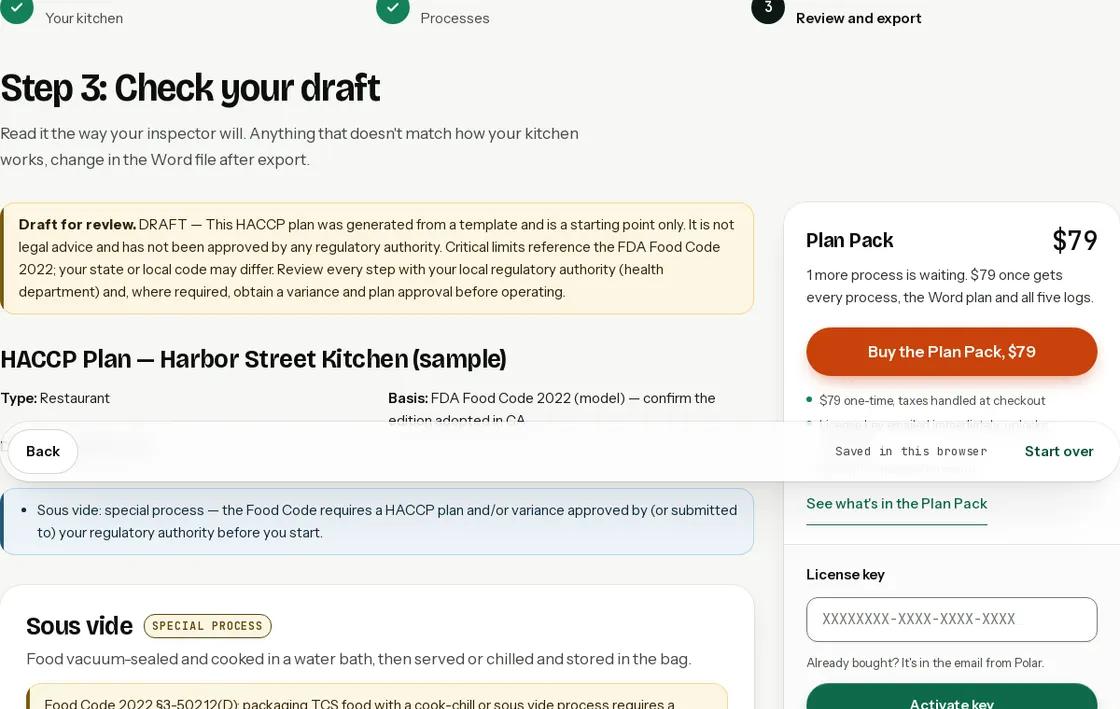
HACCP Plan — Harbor Street Kitchen (sample)
- Type:
- Restaurant
- Basis:
- FDA Food Code 2022 (model) — confirm the edition adopted in OR
- Draft date:
- 2026-10-31
- Address:
- Portland, OR
- Sous vide: special process — the Food Code requires a HACCP plan and/or variance approved by (or submitted to) your regulatory authority before you start.
Sous vide Special process
Food vacuum-sealed and cooked in a water bath, then served or chilled and stored in the bag.
Menu items: Short rib 72h at 140°F, chicken thigh at 155°F
Flow diagram
- 01ReceiveCCP 1
- 02Cold storageCCP 2
- 03Prepare & vacuum package (oxygen-barrier bag)
- 04Cook in water bath (time/temperature per §3-401.11(A)/(B))CCP 3
- 05Cool in sealed bag (ice bath) to 41°F per §3-501.14CCP 4
- 06Refrigerated storage of sealed bagsCCP 5
- 07Rethermalize / finishCCP 6
- 08Serve
Hazard analysis
| Step | Type | Hazard | Significant? | Justification | Control measure |
|---|---|---|---|---|---|
| Receive | Biological | Pathogens present on arrival (Salmonella, E. coli O157:H7, Listeria, C. perfringens) | Yes | Raw animal foods commonly carry pathogens; temperature abuse in transit allows growth. | Approved source; reject TCS food above 41°F or showing temperature abuse. |
| Receive | Chemical | Undeclared allergens; chemical contamination in transit | No | Controlled by supplier programs and prerequisite programs (approved suppliers, label checks). | Check labels and packaging integrity on receipt. |
| Receive | Physical | Foreign objects (packaging, bone fragments, metal) | No | Low likelihood; visual inspection at prep is a prerequisite program. | Visual inspection; reject damaged packages. |
| Cold storage | Biological | Growth of pathogens during refrigerated storage | Yes | TCS food above 41°F supports bacterial growth. | Cold holding at 41°F or below. |
| Cold storage | Biological | Cross-contamination from raw foods, hands, or surfaces | No | Controlled by prerequisite programs: handwashing, no bare-hand contact with RTE food, cleaning and sanitizing, storage order. | SOPs for handwashing, glove use, and sanitizing (see cleaning log). |
| Prepare & vacuum package (oxygen-barrier bag) | Biological | Cross-contamination from raw foods, hands, or surfaces | No | Controlled by prerequisite programs: handwashing, no bare-hand contact with RTE food, cleaning and sanitizing, storage order. | SOPs for handwashing, glove use, and sanitizing (see cleaning log). |
| Prepare & vacuum package (oxygen-barrier bag) | Chemical | Allergen cross-contact; sanitizer residue | No | Controlled by allergen SOP and proper sanitizer concentration. | Separate utensils; test strips for sanitizer. |
| Cook in water bath (time/temperature per §3-401.11(A)/(B)) | Biological | Survival of vegetative pathogens due to undercooking | Yes | Cooking is the step that reduces pathogens to safe levels. | Cook to Food Code minimum internal temperature and time. |
| Cook in water bath (time/temperature per §3-401.11(A)/(B)) | Biological | Clostridium botulinum and Listeria monocytogenes in the reduced-oxygen environment | Yes | Anaerobic conditions favor C. botulinum; Listeria grows at refrigeration temperatures. | Validated time/temperature; rapid chill; strict cold storage time limits. |
| Cool in sealed bag (ice bath) to 41°F per §3-501.14 | Biological | Outgrowth of spore-formers (C. perfringens, B. cereus) during slow cooling | Yes | Spores survive cooking; they multiply rapidly between 135°F and 41°F. | Two-stage cooling within Food Code time limits. |
| Refrigerated storage of sealed bags | Biological | C. botulinum toxin formation and Listeria growth during storage | Yes | Non-proteolytic C. botulinum can grow above 38°F in anaerobic packages. | Store at 34°F (≤30 days) or 41°F (≤7 days), or frozen; label with name and date packaged. |
| Rethermalize / finish | Biological | Survival/growth of pathogens and spore-formers if reheated slowly or insufficiently | Yes | Cooled foods may contain vegetative cells from spore germination. | Rapid reheat to 165°F within 2 hours. |
| Serve | Biological | Cross-contamination from raw foods, hands, or surfaces | No | Controlled by prerequisite programs: handwashing, no bare-hand contact with RTE food, cleaning and sanitizing, storage order. | SOPs for handwashing, glove use, and sanitizing (see cleaning log). |
Critical control points
Receive
Critical limit
41°F (5°C) or below, unless law specifies otherwise (e.g. milk, molluscan shellfish); raw shell eggs in 45°F ambient; frozen received frozen; hot food at 135°F or above
Food Code 2022 §3-202.11- Hazard
- Pathogen growth from temperature abuse before receipt
- Monitoring
- Probe one package per TCS delivery; inspect frozen items for thaw signs. Every delivery, by receiving employee.
- Corrective action
- Reject product above limit or showing temperature abuse; record rejection and notify supplier.
- Verification
- Person in charge reviews receiving log daily; thermometer calibrated weekly (ice-point method).
- Records
- Receiving log; thermometer calibration log; supplier invoices.
Cold storage
Critical limit
41°F (5°C) or below
Food Code 2022 §3-501.16(A)(2)- Hazard
- Pathogen growth during storage
- Monitoring
- Check and record unit air and product temperature at least every 4 hours during operation (or continuous electronic monitoring).
- Corrective action
- If food is above 41°F for less than 4 hours (or unknown time): evaluate per SOP — rapidly chill or discard; repair unit. When in doubt, discard.
- Verification
- Manager reviews temperature log each shift; thermometer calibration weekly.
- Records
- Temperature log; corrective action log.
Cook in water bath (time/temperature per §3-401.11(A)/(B))
Critical limit
Time/temperature table in §3-401.11(B)(1), e.g. 130°F for 112 minutes, 135°F for 36 minutes, 145°F for 4 minutes
Food Code 2022 §3-401.11(B)- Hazard
- Survival of pathogens
- Monitoring
- Probe the thickest part of each batch / each item with a calibrated thermometer; record temperature and time.
- Corrective action
- Continue cooking until the critical limit is reached; retrain staff if repeated.
- Verification
- Manager spot-checks one item per shift and reviews cooking records daily; weekly thermometer calibration.
- Records
- Cooking temperature log; calibration log.
Cool in sealed bag (ice bath) to 41°F per §3-501.14
Critical limit
135°F to 70°F within 2 hours, and 135°F to 41°F within a total of 6 hours
Food Code 2022 §3-501.14(A)- Hazard
- Outgrowth of spore-forming bacteria
- Monitoring
- Record product temperature at start (135°F), at 2 hours, and until 41°F is reached (at least hourly). Use shallow pans (≤2 in. depth), ice baths, ice wands, or a blast chiller.
- Corrective action
- If 70°F not reached within 2 hours: reheat to 165°F and restart cooling, or discard. If 41°F not reached within 6 hours total: discard.
- Verification
- Manager reviews cooling log daily; periodic validation of cooling method for largest batch size.
- Records
- Cooling log; corrective action log.
Refrigerated storage of sealed bags
Critical limit
Cooled to 41°F per §3-501.14, then: 34°F within 48 h and held ≤30 days from packaging; or held at 41°F or less ≤7 days; or 34°F then 41°F ≤7 days not exceeding 30 days; or frozen
Food Code 2022 §3-502.12(D)(2)(e)- Hazard
- C. botulinum / Listeria growth
- Monitoring
- Continuous electronic time/temperature monitoring of the unit, visually checked twice daily; check labels/dates daily.
- Corrective action
- Discard product past its date or held above the chosen storage temperature; repair unit.
- Verification
- Manager reviews electronic records weekly; records retained at least 6 months.
- Records
- Electronic temperature records; cooling log; label/date log.
Rethermalize / finish
Critical limit
165°F (74°C) for 15 seconds, within 2 hours (135°F for commercially processed RTE food)
Food Code 2022 §3-403.11(A),(C),(D)- Hazard
- Survival of pathogens
- Monitoring
- Probe each batch at end of reheating; note start and end time.
- Corrective action
- Continue heating if under 2 hours elapsed; discard if 165°F not reached within 2 hours.
- Verification
- Manager reviews reheating entries daily.
- Records
- Temperature log (reheat column); corrective action log.
Records this plan relies on
- Temperature Log (Cold & Hot Holding)
- Cooling Log
- Receiving Log
- Cleaning & Sanitizing Log
- Corrective Action Log
HACCP Plan — Harbor Street Kitchen (sample)
- Type:
- Restaurant
- Basis:
- FDA Food Code 2022 (model) — confirm the edition adopted in OR
- Draft date:
- 2026-10-31
- Address:
- Portland, OR
Cook-chill / cooling of large batches
Stocks, soups, braises, chili, rice and beans cooked in advance, cooled, stored, and reheated (complex food preparation).
Menu items: Veal stock, braised beans, chili base
Flow diagram
- 01ReceiveCCP 1
- 02Cold storageCCP 2
- 03Prepare / portion
- 04Cook (to the limit for the ingredient)CCP 3
- 05CoolCCP 4
- 06Cold storageCCP 5
- 07Reheat for hot holdingCCP 6
- 08Hot holdCCP 7
- 09Serve
Hazard analysis
| Step | Type | Hazard | Significant? | Justification | Control measure |
|---|---|---|---|---|---|
| Receive | Biological | Pathogens present on arrival (Salmonella, E. coli O157:H7, Listeria, C. perfringens) | Yes | Raw animal foods commonly carry pathogens; temperature abuse in transit allows growth. | Approved source; reject TCS food above 41°F or showing temperature abuse. |
| Receive | Chemical | Undeclared allergens; chemical contamination in transit | No | Controlled by supplier programs and prerequisite programs (approved suppliers, label checks). | Check labels and packaging integrity on receipt. |
| Receive | Physical | Foreign objects (packaging, bone fragments, metal) | No | Low likelihood; visual inspection at prep is a prerequisite program. | Visual inspection; reject damaged packages. |
| Cold storage | Biological | Growth of pathogens during refrigerated storage | Yes | TCS food above 41°F supports bacterial growth. | Cold holding at 41°F or below. |
| Cold storage | Biological | Cross-contamination from raw foods, hands, or surfaces | No | Controlled by prerequisite programs: handwashing, no bare-hand contact with RTE food, cleaning and sanitizing, storage order. | SOPs for handwashing, glove use, and sanitizing (see cleaning log). |
| Prepare / portion | Biological | Cross-contamination from raw foods, hands, or surfaces | No | Controlled by prerequisite programs: handwashing, no bare-hand contact with RTE food, cleaning and sanitizing, storage order. | SOPs for handwashing, glove use, and sanitizing (see cleaning log). |
| Prepare / portion | Chemical | Allergen cross-contact; sanitizer residue | No | Controlled by allergen SOP and proper sanitizer concentration. | Separate utensils; test strips for sanitizer. |
| Cook (to the limit for the ingredient) | Biological | Survival of vegetative pathogens due to undercooking | Yes | Cooking is the step that reduces pathogens to safe levels. | Cook to Food Code minimum internal temperature and time. |
| Cool | Biological | Outgrowth of spore-formers (C. perfringens, B. cereus) during slow cooling | Yes | Spores survive cooking; they multiply rapidly between 135°F and 41°F. | Two-stage cooling within Food Code time limits. |
| Cold storage | Biological | Growth of pathogens during refrigerated storage | Yes | TCS food above 41°F supports bacterial growth. | Cold holding at 41°F or below. |
| Cold storage | Biological | Cross-contamination from raw foods, hands, or surfaces | No | Controlled by prerequisite programs: handwashing, no bare-hand contact with RTE food, cleaning and sanitizing, storage order. | SOPs for handwashing, glove use, and sanitizing (see cleaning log). |
| Reheat for hot holding | Biological | Survival/growth of pathogens and spore-formers if reheated slowly or insufficiently | Yes | Cooled foods may contain vegetative cells from spore germination. | Rapid reheat to 165°F within 2 hours. |
| Hot hold | Biological | Growth of spore-formers / toxin production during hot holding | Yes | Food below 135°F allows growth of surviving spore-formers. | Hold at 135°F or above. |
| Serve | Biological | Cross-contamination from raw foods, hands, or surfaces | No | Controlled by prerequisite programs: handwashing, no bare-hand contact with RTE food, cleaning and sanitizing, storage order. | SOPs for handwashing, glove use, and sanitizing (see cleaning log). |
Critical control points
Receive
Critical limit
41°F (5°C) or below, unless law specifies otherwise (e.g. milk, molluscan shellfish); raw shell eggs in 45°F ambient; frozen received frozen; hot food at 135°F or above
Food Code 2022 §3-202.11- Hazard
- Pathogen growth from temperature abuse before receipt
- Monitoring
- Probe one package per TCS delivery; inspect frozen items for thaw signs. Every delivery, by receiving employee.
- Corrective action
- Reject product above limit or showing temperature abuse; record rejection and notify supplier.
- Verification
- Person in charge reviews receiving log daily; thermometer calibrated weekly (ice-point method).
- Records
- Receiving log; thermometer calibration log; supplier invoices.
Cold storage
Critical limit
41°F (5°C) or below
Food Code 2022 §3-501.16(A)(2)- Hazard
- Pathogen growth during storage
- Monitoring
- Check and record unit air and product temperature at least every 4 hours during operation (or continuous electronic monitoring).
- Corrective action
- If food is above 41°F for less than 4 hours (or unknown time): evaluate per SOP — rapidly chill or discard; repair unit. When in doubt, discard.
- Verification
- Manager reviews temperature log each shift; thermometer calibration weekly.
- Records
- Temperature log; corrective action log.
Cook (to the limit for the ingredient)
Critical limit
165°F (74°C) or above for <1 second (instantaneous)
Food Code 2022 §3-401.11(A)(3)- Hazard
- Survival of pathogens
- Monitoring
- Probe the thickest part of each batch / each item with a calibrated thermometer; record temperature and time.
- Corrective action
- Continue cooking until the critical limit is reached; retrain staff if repeated.
- Verification
- Manager spot-checks one item per shift and reviews cooking records daily; weekly thermometer calibration.
- Records
- Cooking temperature log; calibration log.
Cool
Critical limit
135°F to 70°F within 2 hours, and 135°F to 41°F within a total of 6 hours
Food Code 2022 §3-501.14(A)- Hazard
- Outgrowth of spore-forming bacteria
- Monitoring
- Record product temperature at start (135°F), at 2 hours, and until 41°F is reached (at least hourly). Use shallow pans (≤2 in. depth), ice baths, ice wands, or a blast chiller.
- Corrective action
- If 70°F not reached within 2 hours: reheat to 165°F and restart cooling, or discard. If 41°F not reached within 6 hours total: discard.
- Verification
- Manager reviews cooling log daily; periodic validation of cooling method for largest batch size.
- Records
- Cooling log; corrective action log.
Cold storage
Critical limit
41°F (5°C) or below
Food Code 2022 §3-501.16(A)(2)- Hazard
- Pathogen growth during storage
- Monitoring
- Check and record unit air and product temperature at least every 4 hours during operation (or continuous electronic monitoring).
- Corrective action
- If food is above 41°F for less than 4 hours (or unknown time): evaluate per SOP — rapidly chill or discard; repair unit. When in doubt, discard.
- Verification
- Manager reviews temperature log each shift; thermometer calibration weekly.
- Records
- Temperature log; corrective action log.
Reheat for hot holding
Critical limit
165°F (74°C) for 15 seconds, within 2 hours (135°F for commercially processed RTE food)
Food Code 2022 §3-403.11(A),(C),(D)- Hazard
- Survival of pathogens
- Monitoring
- Probe each batch at end of reheating; note start and end time.
- Corrective action
- Continue heating if under 2 hours elapsed; discard if 165°F not reached within 2 hours.
- Verification
- Manager reviews reheating entries daily.
- Records
- Temperature log (reheat column); corrective action log.
Hot hold
Critical limit
135°F (57°C) or above (130°F for roasts cooked per §3-401.11(B))
Food Code 2022 §3-501.16(A)(1)- Hazard
- Growth of pathogens
- Monitoring
- Probe product temperature at least every 2 hours (checking every 2 hours leaves time to reheat before food has been out of control for 4 hours).
- Corrective action
- If below 135°F for less than 2 hours since last good check: reheat to 165°F. Otherwise discard.
- Verification
- Manager reviews hot holding log each shift.
- Records
- Temperature log; corrective action log.
Records this plan relies on
- Temperature Log (Cold & Hot Holding)
- Cooling Log
- Receiving Log
- Cleaning & Sanitizing Log
- Corrective Action Log
HACCP Plan — Harbor Street Kitchen (sample)
- Type:
- Restaurant
- Basis:
- FDA Food Code 2022 (model) — confirm the edition adopted in OR
- Draft date:
- 2026-10-31
- Address:
- Portland, OR
- Raw fish & sushi rice: special process — the Food Code requires a HACCP plan and/or variance approved by (or submitted to) your regulatory authority before you start.
Raw fish & sushi rice Special process
Sushi, sashimi, crudo, poke, and acidified sushi rice held at room temperature.
Menu items: Nigiri and maki rice, acidified with seasoned vinegar
Flow diagram
- 01ReceiveCCP 1
- 02Freeze for parasite destruction (or supplier letter)CCP 2
- 03Cold storageCCP 3
- 04Cook & acidify riceCCP 4
- 05Prepare (no bare-hand contact with RTE food)
- 06Serve
Hazard analysis
| Step | Type | Hazard | Significant? | Justification | Control measure |
|---|---|---|---|---|---|
| Receive | Biological | Pathogens present on arrival (Salmonella, E. coli O157:H7, Listeria, C. perfringens) | Yes | Raw animal foods commonly carry pathogens; temperature abuse in transit allows growth. | Approved source; reject TCS food above 41°F or showing temperature abuse. |
| Receive | Chemical | Undeclared allergens; chemical contamination in transit | No | Controlled by supplier programs and prerequisite programs (approved suppliers, label checks). | Check labels and packaging integrity on receipt. |
| Receive | Physical | Foreign objects (packaging, bone fragments, metal) | No | Low likelihood; visual inspection at prep is a prerequisite program. | Visual inspection; reject damaged packages. |
| Freeze for parasite destruction (or supplier letter) | Biological | Parasites (Anisakis, tapeworms) | Yes | Wild fish may contain parasites; freezing is the control for raw service. | Freezing per §3-402.11 or supplier documentation; keep records 90 days. |
| Cold storage | Biological | Growth of pathogens during refrigerated storage | Yes | TCS food above 41°F supports bacterial growth. | Cold holding at 41°F or below. |
| Cold storage | Biological | Cross-contamination from raw foods, hands, or surfaces | No | Controlled by prerequisite programs: handwashing, no bare-hand contact with RTE food, cleaning and sanitizing, storage order. | SOPs for handwashing, glove use, and sanitizing (see cleaning log). |
| Cook & acidify rice | Biological | Bacillus cereus growth and toxin formation in rice held at room temperature | Yes | Spores survive cooking; rice is TCS unless acidified. | Acidify to validated pH (Annex 4 example: pH < 4.2). |
| Prepare (no bare-hand contact with RTE food) | Biological | Cross-contamination from raw foods, hands, or surfaces | No | Controlled by prerequisite programs: handwashing, no bare-hand contact with RTE food, cleaning and sanitizing, storage order. | SOPs for handwashing, glove use, and sanitizing (see cleaning log). |
| Prepare (no bare-hand contact with RTE food) | Chemical | Allergen cross-contact; sanitizer residue | No | Controlled by allergen SOP and proper sanitizer concentration. | Separate utensils; test strips for sanitizer. |
| Serve | Biological | Cross-contamination from raw foods, hands, or surfaces | No | Controlled by prerequisite programs: handwashing, no bare-hand contact with RTE food, cleaning and sanitizing, storage order. | SOPs for handwashing, glove use, and sanitizing (see cleaning log). |
Critical control points
Receive
Critical limit
41°F (5°C) or below, unless law specifies otherwise (e.g. milk, molluscan shellfish); raw shell eggs in 45°F ambient; frozen received frozen; hot food at 135°F or above
Food Code 2022 §3-202.11- Hazard
- Pathogen growth from temperature abuse before receipt
- Monitoring
- Probe one package per TCS delivery; inspect frozen items for thaw signs. Every delivery, by receiving employee.
- Corrective action
- Reject product above limit or showing temperature abuse; record rejection and notify supplier.
- Verification
- Person in charge reviews receiving log daily; thermometer calibrated weekly (ice-point method).
- Records
- Receiving log; thermometer calibration log; supplier invoices.
Freeze for parasite destruction (or supplier letter)
Critical limit
Frozen and stored at -4°F (-20°C) or below for 168 hours (7 days); or -31°F (-35°C) until solid and stored at -31°F for 15 hours; or -31°F until solid and stored at -4°F for 24 hours (exemptions for certain tuna species, molluscan shellfish, some aquacultured fish)
Food Code 2022 §3-402.11- Hazard
- Parasites
- Monitoring
- Record freezer temperature and freeze start/end time for each batch, or retain supplier freezing letter.
- Corrective action
- Re-freeze for full duration or cook the fish; do not serve raw.
- Verification
- Manager reviews freezing records weekly.
- Records
- Freezing log or supplier letters (kept 90 days after service per §3-402.12).
Cold storage
Critical limit
41°F (5°C) or below
Food Code 2022 §3-501.16(A)(2)- Hazard
- Pathogen growth during storage
- Monitoring
- Check and record unit air and product temperature at least every 4 hours during operation (or continuous electronic monitoring).
- Corrective action
- If food is above 41°F for less than 4 hours (or unknown time): evaluate per SOP — rapidly chill or discard; repair unit. When in doubt, discard.
- Verification
- Manager reviews temperature log each shift; thermometer calibration weekly.
- Records
- Temperature log; corrective action log.
Cook & acidify rice
Critical limit
pH below 4.2 (Food Code Annex 4 example critical limit); acidifying rice to make it non-TCS requires a variance
Food Code 2022 Annex 4 (Principle 3) and §3-502.11(C)- Hazard
- B. cereus growth
- Monitoring
- Measure pH of each batch with a calibrated pH meter or strips after mixing; record.
- Corrective action
- Add more vinegar solution and re-test, or treat rice as TCS (hold at 41°F/135°F) or discard.
- Verification
- Daily pH meter calibration; manager reviews pH log daily.
- Records
- Sushi rice pH log; pH meter calibration log.
Records this plan relies on
- Temperature Log (Cold & Hot Holding)
- Receiving Log
- Cleaning & Sanitizing Log
- Corrective Action Log
Cooling Log
Sample: Harbor Street Kitchen
Start the clock when food is at 135°F. 135°F to 70°F within 2 hours, and 135°F to 41°F within a total of 6 hours. Record at 0 h, 2 h, and until 41°F.
| Date | Food item | Start time | Start temp (°F) | 2-hr time | 2-hr temp (≤70°F) | Final time | Final temp (≤41°F) | Method | Corrective action | Initials |
|---|---|---|---|---|---|---|---|---|---|---|
| 10/14 | Veal stock, 4 gal | 2:10 pm | 158 | 4:05 pm | 66 | 8:30 pm | 39 | Ice wand, 2" pans | MR | |
| 10/14 | Braised beans | 3:00 pm | 171 | 4:55 pm | 74 | Blast chiller | Reheated to 165°F, restarted | MR | ||
Real log sheet
Do I need a temperature log too?
Yes. A plan without records won't get far, so the builder makes the logs from the same limits as the plan. That second row is what a missed cooling check looks like: 74°F at two hours, so the cook reheated and started again.
The temperature log is free, even if you never buy anything.
When is a HACCP plan required for a restaurant?
Most kitchens don't need one for ordinary cook-and-serve. Under Food Code §8-201.13 you do need one before you:
- vacuum pack, cook-chill or hold sous vide food under §3-502.12
- cure, or smoke to preserve rather than flavor
- acidify sushi rice so it can sit out of temperature control
- ask for any other variance under §3-502.11
How is this different from a consultant?
| Feature | Consultant | Subscription app | Blank template | This builder |
|---|---|---|---|---|
| Price | Usually $600 to $9,500 per plan | Monthly subscription | Free | $79 once |
| Critical limits filled in | Yes | Varies | No, you look them up | Yes, with Food Code section |
| Visits your kitchen, validates process | Yes | No | No | No |
| Monitoring logs | Sometimes | Digital | Sometimes | 5 printable logs |
| Time to a first draft | Weeks | Days of setup | Days of typing | About an hour |
If you need someone to validate a cure or argue a variance, hire the consultant. This gets their time spent on review.
How much does a HACCP plan cost here?
The builder and your first process are free. The Plan Pack is $79, paid once: every process, Word export and all five logs. Your license key arrives by email straight after checkout, and you have 14 days to ask for a full refund.
FAQ
Questions owners ask before they start
Something we didn't answer? The about page says who we are and how to reach us.
01Will my health department accept it?
We can't promise that, and nobody honest can. What you get is a draft laid out the way FDA Food Code §8-201.14 lists a plan's contents: product categories, a flow diagram per process, a CCP summary with limits, monitoring, corrective actions, verification and records. That's the structure inspectors review against. Expect them to ask for your recipes, your equipment and sometimes validation data, especially for curing and dry aging.
02Is this legal advice?
No. It's a drafting tool that cites the FDA Food Code 2022 next to every limit so you and your inspector can check the source. Your state may run an older code edition or add its own rules, and your regulatory authority has the final say.
03Do I need a variance?
Sometimes. Food Code §3-502.11 requires a variance for smoking or curing as preservation, acidifying sushi rice to skip time and temperature control, reduced oxygen packaging outside §3-502.12, live shellfish tanks and sprouting seeds. Cook-chill, sous vide and vacuum packing that follow §3-502.12 need a HACCP plan but no variance. The builder flags which case you're in for each process.
04How is this different from a consultant or FoodDocs?
A consultant can visit your kitchen, validate your process and talk to the inspector for you, and quotes we found ran from about $600 to $9,500 per plan. FoodDocs is a subscription food safety system with digital monitoring. We're neither. You pay $79 once for a cited first draft and printable logs, then spend any consultant time on review instead of typing.
05What if my process isn't listed?
The builder covers 14 processes, from receiving and cold holding to sous vide, vacuum packing, curing, dry aging, sushi rice, shellfish and eggs. If yours isn't there, pick the closest one and edit the Word file. If it's something like fermentation or high pressure processing, talk to your inspector first, because they'll likely want a process authority's letter.
06Can I edit the plan?
Yes. The Plan Pack exports a normal Word .docx file. Change the wording, add your recipes, swap in your own forms. Your answers also stay saved in your browser, so you can come back, change a step and export again.
07What exactly do I get for $79?
Every process in the plan, not just the first one. A Word .docx you can edit and a print-ready HTML version of the plan. Five monitoring logs: temperature, cooling, receiving, cleaning and sanitizing, and corrective action, each as Word, CSV and print-ready HTML. It's a one-time payment with no subscription.
08What if it isn't right for me?
Email us within 14 days of buying and we'll refund you in full. No questions, and you don't need to explain why.
09Where does my data go?
Nowhere until you export. Your answers are kept in your own browser's storage. When you click export, the plan is sent to our server just long enough to build the file and isn't stored. We don't use accounts.